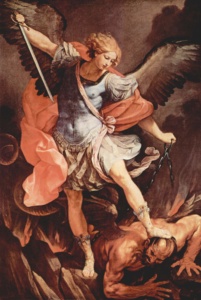
Saint Michael is one of the principal angels; his name was the war-cry of the good angels in the battle fought in heaven against the enemy and his followers. Christian tradition gives to St. Michael four offices:
To fight against Satan.
To rescue the souls of the faithful from the power of the enemy,
especially at the hour of death.
To be the champion of God’s people, the Jews in the Old Law, the
Christians in the New Testament; therefore he was the patron of
the Church, and of the orders of knights during the Middle Ages.
To call away from earth and bring men’s souls to judgment.
 It would have been natural to St. Michael, the champion of the Jewish people, to be the champion also of Christians, giving victory in war to his clients. The early Christians, however, regarded some of the martyrs as their military patrons: St. George, St. Theodore, St. Demetrius, St. Sergius, St. Procopius, St. Mercurius, etc.; but to St. Michael they gave the care of their sick. At the place where he was first venerated, in Phrygia, his prestige as angelic healer obscured his interposition in military affairs. It was from early times the center of the true cult of the holy angels, particularly of St. Michael. Tradition relates that St. Michael in the earliest ages caused a medicinal spring to spout at Chairotopa near Colossae, where all the sick who bathed there, invoking the Blessed Trinity and St. Michael, were cured.
Well known is the apparition of St. Michael (around 494), as related in the Roman Breviary, May 8, at his renowned sanctuary on Monte Gargano, where his original glory as patron in war was restored to him. To his intercession the Lombards of Sipontum (Manfredonia) attributed
their victory over the Greek Neapolitans, May 8, 663. In commemoration of this victory the church of Sipontum instituted a special feast in honour of the archangel, on May 8, which has spread over the entire Latin Church and is now called (since the time of Pius V) “Apparitio S. Michaelis”, although it originally did not commemorate the apparition, but the victory.
NewAdvent.org